
7 Tips for Choosing Concrete Floor Diamond Saw Blades
Choosing the right Concrete Floor Diamond Saw Blades affects cutting speed, finish quality, dust control, and operating cost. A blade that glides through cured concrete can still struggle against dense aggregate or embedded steel. The visible rim tells only part of the story. Segment height, bond hardness, diamond concentration, cooling method, and machine compatibility matter equally.
Industry evidence supports a careful approach. The U.S. Geological Survey’s Mineral Commodity Summaries documents concrete’s continued importance in global construction, while Grand View Research reports sustained growth in construction and concrete equipment demand. These trends increase pressure to cut faster without sacrificing accuracy. OSHA’s respirable crystalline silica standard sets a permissible exposure limit of 50 micrograms per cubic meter over an eight-hour shift. Wet cutting, suitable equipment, and disciplined maintenance remain essential controls. The blade is not a dust solution by itself.
Real jobsite experience adds another layer. A 14-inch blade cutting a 100-millimeter slab may perform differently in wet limestone aggregate than in hard granite aggregate. Listen for uneven vibration. Watch the kerf, slurry flow, and motor load. Those small signals often reveal a poor bond before the blade fails. No selection method is perfect. That matters. Operators sometimes trust diameter alone, although RPM, cutting depth, concrete age, reinforcement, and saw power can change the result. These seven practical tips connect manufacturer guidance, safety data, and field observations, helping professionals choose Concrete Floor Diamond Saw Blades with better judgment and fewer costly surprises.
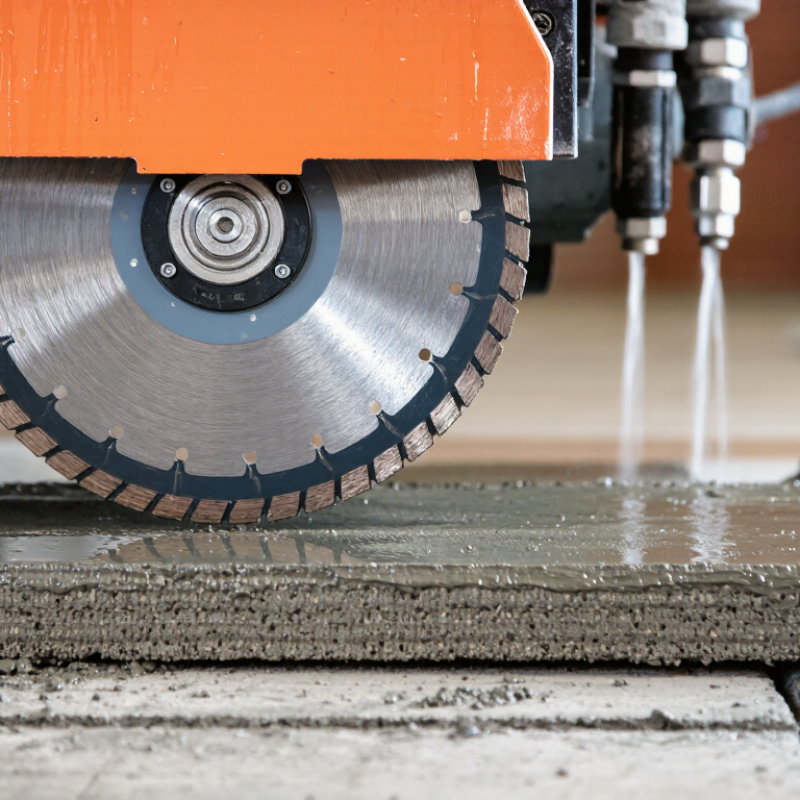
Identify the Concrete Type, Thickness, and Cutting Conditions
7 Tips for Choosing Concrete Floor Diamond Saw Blades
Identify the concrete type before selecting a diamond blade. Cured concrete may contain hard aggregate, soft aggregate, or recycled material. Each wears the diamond segments differently. Reinforced concrete needs a blade designed to pass through steel without excessive vibration. Green concrete behaves differently because it still holds moisture and may contain loose particles. Check the slab age and aggregate exposure. Do not rely on color alone.
Thickness controls the required cutting depth and blade diameter. Measure the slab at several points, especially near joints and edges. A floor may not be uniform. The blade should cut deeply enough without forcing the machine. Leave clearance for the saw guard and arbor system. Check the saw’s horsepower, rotation speed, and maximum blade size. A powerful saw can still cut poorly with an unsuitable blade.
Cutting conditions deserve equal attention. Wet cutting helps control dust and cools the blade, while dry cutting needs careful airflow and short passes. Inspect for rebar, embedded pipes, and previous repairs before starting. Mark the line clearly. Check the dust. Hard aggregate can slow cutting, but excessive pressure usually creates heat and uneven wear. In field work, selection charts help, though they sometimes oversimplify mixed slabs. A small test cut can reveal more than assumptions. Listen for vibration, watch the segment wear, and adjust the cutting pace when conditions change.
7 Tips for Choosing Concrete Floor Diamond Saw Blades - Identify the Concrete Type, Thickness, and Cutting Conditions
| Tip | Concrete Type or Condition | What to Check | Recommended Blade Characteristics | Typical Cutting Method | Practical Guidance |
|---|---|---|---|---|---|
| 1 | Identify the aggregate hardness | Determine whether the slab contains hard aggregate such as granite or basalt, medium aggregate such as crushed limestone, or softer aggregate such as softer limestone. | Hard aggregate generally needs a softer, faster-wearing bond so new diamond is exposed. Soft aggregate generally needs a harder bond to reduce premature wear. | Wet cutting is preferred for longer blade life and dust control when the equipment and site allow water. | If the concrete source is unknown, inspect an exposed edge or make a short test cut before selecting a large quantity of blades. |
| 2 | Distinguish green concrete from cured concrete | Check the concrete age, compressive strength, moisture condition, and whether the cut is a planned control joint. | Green-concrete blades are designed for early-age concrete and may use a different bond from blades intended for fully cured slabs. | Early-entry dry cutting may be used for shallow control joints when the slab and equipment are suitable. | Cutting too early can cause raveling and joint damage; cutting too late can allow uncontrolled cracking. Follow the project specification and concrete conditions. |
| 3 | Match blade diameter to slab thickness | Measure the actual slab thickness and account for the required cutting depth, saw clearance, and any reinforcement. | Choose a blade diameter and arbor size approved for the saw. The blade must provide the required depth without exceeding the machine guard limits. | Use staged passes for thick slabs when recommended by the saw manufacturer, rather than forcing one deep pass. | A common control-joint depth is approximately one-quarter of the slab thickness, but the project design, reinforcement, and local requirements take priority. |
| 4 | Check for steel reinforcement, mesh, or embedded items | Look for rebar, welded wire mesh, post-tensioning cables, conduits, pipes, and other hidden materials before cutting. | Use a reinforced-concrete blade with a segment design suitable for intermittent metal contact, while maintaining the correct cutting speed. | Wet cutting is often beneficial because it helps cool the blade during demanding cuts. | Never cut into post-tensioned concrete without documented scanning, engineering approval, and a controlled cutting procedure. |
| 5 | Choose wet or dry cutting based on site conditions | Assess water availability, drainage, electrical safety, indoor air quality, dust restrictions, and cleanup requirements. | Use a blade specifically rated for wet or dry operation. Do not assume that a wet-rated blade is suitable for dry cutting. | Wet cutting suppresses respirable silica dust and cools the blade. Dry cutting requires effective dust extraction and suitable respiratory protection. | Follow applicable silica-control requirements and stop work if dust, overheating, or poor visibility cannot be controlled. |
| 6 | Match the blade to the saw and operating speed | Verify arbor diameter, maximum blade RPM, saw horsepower, blade guard capacity, and whether the saw is walk-behind, hand-held, or floor-mounted. | Select a blade whose maximum rated RPM is at least the saw spindle speed and whose arbor configuration fits without unsafe modification. | Keep the blade running within the manufacturer’s recommended surface speed range; avoid excessive feed pressure. | An undersized or incorrectly mounted blade can damage the equipment, produce poor cuts, or create a serious safety hazard. |
| 7 | Consider finish quality and cutting speed | Define whether the priority is a clean decorative cut, fast production cutting, low chipping, or maximum blade life. | Continuous-rim or closely spaced segments may provide smoother edges, while larger gullets and suitable segment spacing can improve debris removal and cutting speed. | Use steady feed pressure, adequate cooling, and periodic inspection of segment wear and blade alignment. | A practical test cut should evaluate cutting rate, edge quality, vibration, blade wear, and dust or slurry control before full production. |
Safety note: Always follow the saw and blade manufacturer’s instructions, inspect the blade before use, wear appropriate personal protective equipment, and verify the location of hidden utilities and reinforcement before cutting.
FAQS
Match the blade diameter with the saw’s approved range and required cutting depth. A 350 mm blade at 3,000 rpm reaches about 55 m/s at the rim. Check the maximum rated speed carefully. Bigger is not always better.
Measure the arbor hole precisely. Common sizes include 20 mm, 25.4 mm, and 30 mm. The hole, drive pin, flange, and spindle must fit without movement. Do not use an improvised reducer.
Confirm guard clearance, shaft direction, power rating, and wet or dry compatibility. The blade should run smoothly without rubbing the guard. Check everything at the jobsite.
Hard aggregate usually needs a softer bond. Abrasive aggregate generally needs a harder bond. Exposed stone, repair patches, and reinforcement can change cutting behavior.
Tall segments often provide longer service life. Narrow segments may cut faster and leave cleaner edges. Wider segments can tolerate uneven floors and occasional impacts. More segments may improve stability but reduce cutting speed.
A shiny segment face may indicate glazing from a bond that is too hard. Rapid diamond loss and uneven wear may indicate a bond that is too soft. Make a short test cut. Watch speed, slurry flow, dust, and wear.
Wet cutting can reduce dust and blade temperature. Water may be unsuitable near electrical equipment or sensitive flooring. Dry cutting requires shorter passes and cooling pauses. The work area decides.
Inspect segment height, core flatness, joint quality, and segment consistency. Reject blades with cracks or uneven segments. Record cutting metres on similar concrete. Cost per metre matters more than purchase price.
Keep the blade aligned with the cutting line. Use steady passes and avoid forcing the saw. Excessive pressure can overheat the core, even during a fast cut. I once blamed blade quality too quickly; operator pressure was part of the problem.
Not completely. Flange position, blade wear, and saw clearance reduce actual depth. Measure the real cutting depth during setup. Service-life estimates are also imperfect because concrete and operator technique vary.
Conclusion
Choosing the right Concrete Floor Diamond Saw Blades starts with understanding the job. Identify the concrete type, thickness, and cutting conditions, including whether the material is cured, reinforced, dry, or wet. Then confirm the required blade diameter, arbor size, and compatibility with your saw to ensure stable and efficient operation. Segment design and bond hardness should match the concrete’s abrasiveness and strength, helping balance cutting speed with blade control.
Quality should also be evaluated through expected service life, cutting performance, and consistency rather than price alone. Review important safety features, proper operating procedures, and maintenance requirements before making a final decision. A blade that lasts longer, cuts cleanly, and reduces replacement or downtime costs may provide better overall value. By comparing performance, durability, safety, and total ownership cost, you can select a blade that supports accurate, efficient, and reliable concrete floor cutting.
